
NurSalah
Learn to pray — step by step
A distraction-free guide to the five prayers: every posture with Arabic text and translation, plus wudū in thirteen steps, the washing steps illustrated. Prayer times and qibla round it off — they are not the core.
For converts, those returning to practice and anyone who wants to practise mindfully.
From the app
Wudū in thirteen steps
The app walks through the ritual washing: thirteen steps, every washing step illustrated, each with Arabic text, transliteration and translation.
The app marks each step as obligatory (fard), sunnah or dhikr.
The steps can also run on their own, at a speed you set.
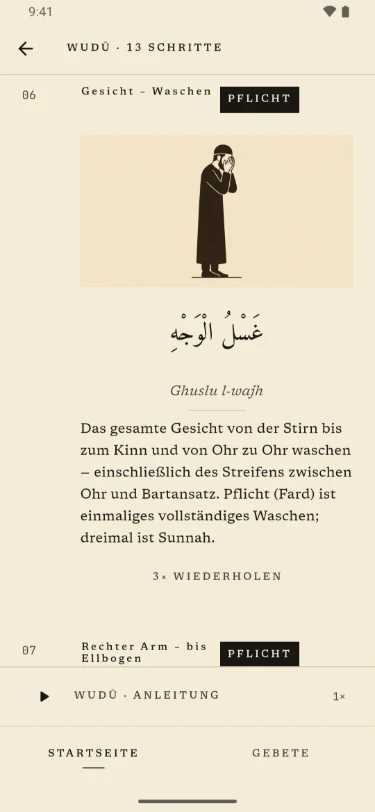
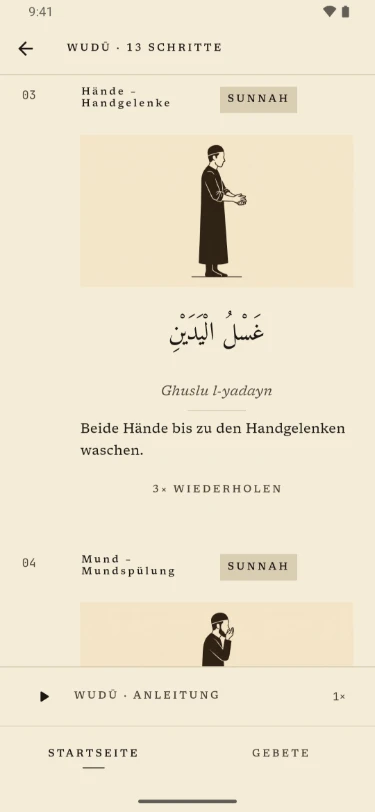
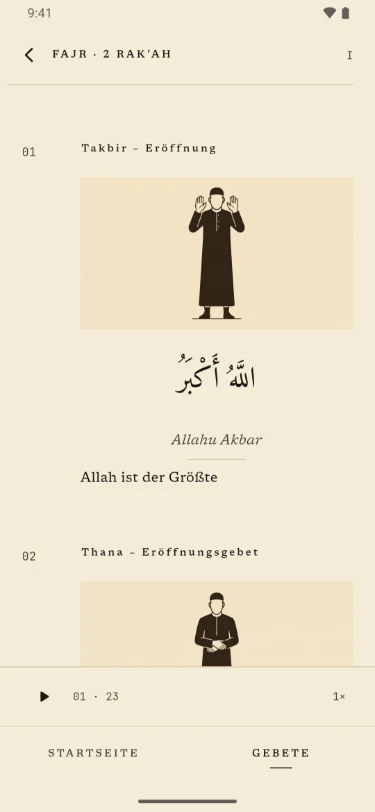
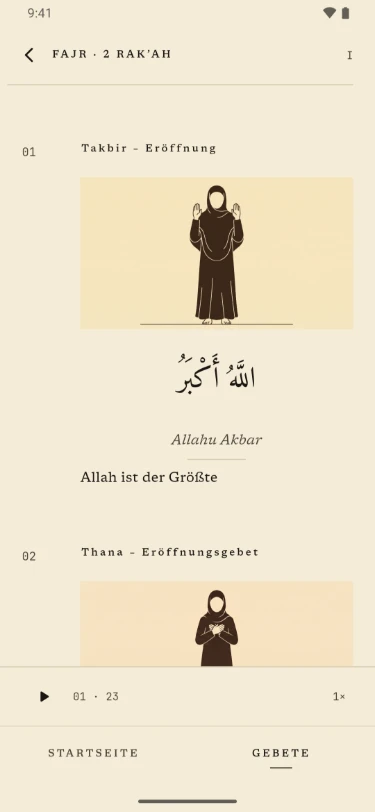
Male and female illustrations
In the settings the illustrations can be switched between a male and a female figure.
The setting applies throughout the app — in the wudū guide as well as in the prayer postures.
The female prayer postures follow the Hanafi school and differ in parts from the male ones.
After the prayer
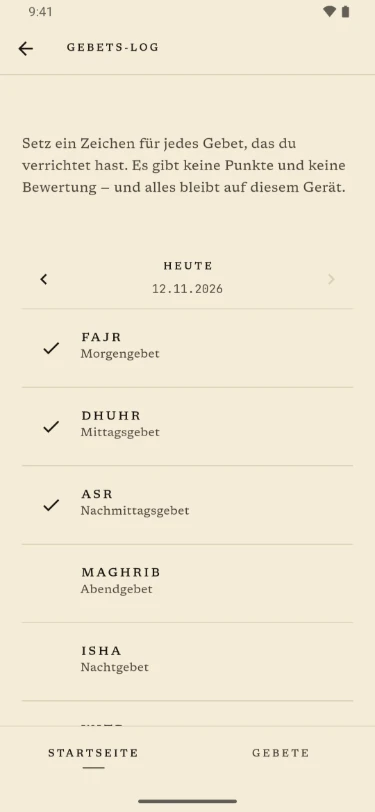
In the prayer log you mark your prayers; a make-up counter keeps track of missed prayers. Both stay on the device.
After the prayer, the app counts the dhikr with you — Subḥāna-llāh, Al-ḥamdu li-llāh and Allāhu akbar.
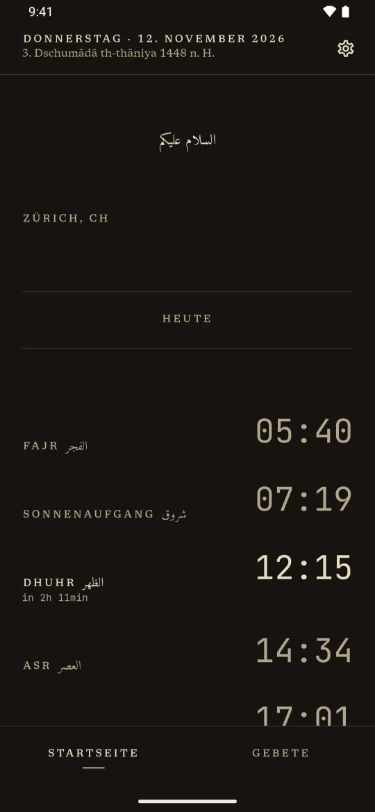
The night view shows the app in dark colours, automatically for Fajr, Isha and Witr if you like.
What the app does
- Ad-free, no account, no cloud storage
- The five prayers, posture by posture — Arabic text, transliteration and translation
- Wudū in thirteen steps, every washing step illustrated
- The app marks every wudū step as obligatory (fard), sunnah or dhikr
- Prayer times by GPS, using the Turkish calculation method
- Qibla via the device compass
- In the app: a prayer log with a make-up counter, dhikr after the prayer and a night view
At a glance
- Languages in the app
- Deutsch · English · Türkçe · Français · Русский · Español · Bosanski · Shqip
- Platforms
- Android · iOS
- Price
- Free · In-app purchases
- Data collection
- Crash logs · Order data · Sales reports
- Account
- Not required
Harun Mustafa was born a Muslim, yet only found Islam for himself later on. For a long time he was too shy to ask how to pray. NurSalah is the app he would have needed back then.
How is the content made?
NurSalah’s contents (prayers, wudū, translations) are written to the best of our knowledge and follow the Hanafi school. Every piece of content names its sources at the end; all of them are collected under Settings → About the app. The contents are checked by the community: anyone who finds a mistake taps ‘Report an error · suggest a correction’ at the end of the content and sends a prepared e-mail to support.
What we don’t collect
The app collects crash data only (Firebase Crashlytics), not linked to you. No tracking, no account, no ads.
Prayer texts, the wudū guide and prayer times work without an internet connection. The app only goes online for crash reports, for the place name shown if you share your location, and for a purchase through your device’s store if you support development.